Second Funifor Cable Car: Full Capacity Access To The Birg-Schilthorn Ski Area
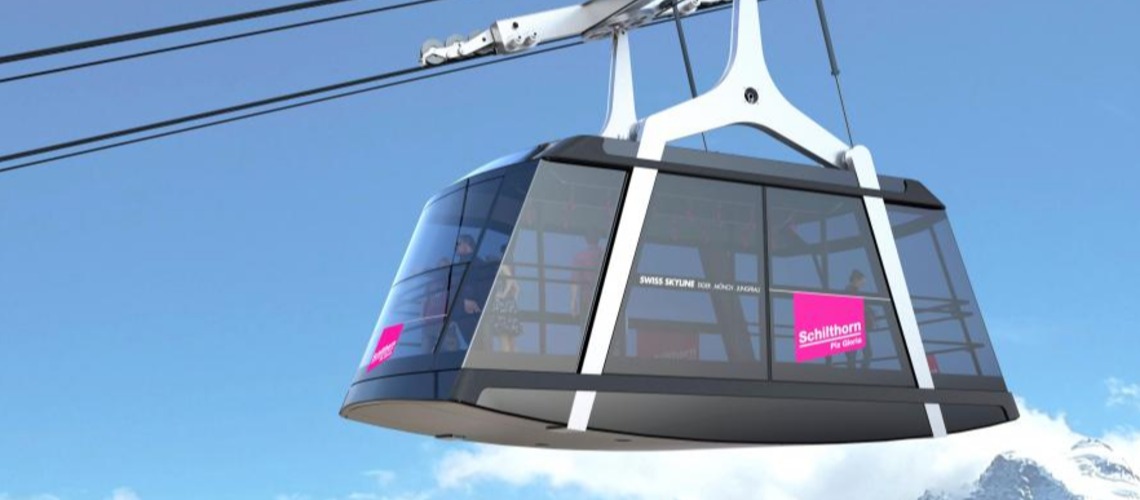
Just in time for the start of the busy winter season, the second Funifor cable car between Mürren and Birg went into operation on Friday, November 28, 2025. This will bring the line to its full capacity of 800 people per hour. The construction phase – from cable installation to commissioning – lasted six months.
Almost a year after the opening of the first Funifor cable car between Mürren and Birg, the second track will also go into operation on Friday, November 28, 2025. It is the second-to-last cable car to open as part of the major SCHILTHORNBAHN 20XX project. The staggered commissioning highlights an important feature of the new cable cars: they are mechanically independent. If necessary, for example during maintenance, only one track needs to be shut down, allowing operation 365 days a year. "Normally, the two tracks are electrically coupled and operated as a 'classic' aerial tramway," explains Daniel Gertsch, Head of Cableways at Schilthornbahn AG. Each cable car has a capacity of 100 people; together they achieve a maximum transport capacity of 800 people per hour. "This increase in capacity comes at just the right time," says Gertsch, looking ahead to the upcoming peak winter season.
The Funifor
What exactly is a Funifor? "A Funifor is an aerial tramway with two parallel track cables, spaced approximately equal to or greater than the width of the cabins below," explains cable car expert Gertsch. On the Funifor lines at the Schilthorn, the track cables have a gauge of 4.6 meters, while the cabins are 3.75 meters wide. This large distance between the track cables prevents lateral swaying and thus guarantees high wind stability. Between Mürren and Birg, the lines cover a distance of 2,765 meters. The cables rest on a single 58-meter-high support tower in the lower section of the route. To minimize sag in the haul ropes, orange intermediate rope hangers are mounted at regular intervals on each track. Traveling at a remarkable speed of 12 meters per second – around 43 kilometers per hour – the cabins cover the 1,036 meters of elevation gain between the stations in just five minutes. Both lines are designed for unattended operation. The second lane can also be driven with an additional load of up to eight tons.
"Brought to life piece by piece"
Construction of the second Funifor track began immediately after the demolition of the old cable car last April. Following successful cable installation over the summer months, the cabin was attached at the beginning of September. "A cable car is brought to life step by step," says Gertsch. "First, we check the entire control system for the safety report and measure the distances between the pylons and stations during operation. Correctly adjusting the brake hydraulics is also crucial, followed by brake tests under full load," Gertsch explains, listing some of the necessary tasks before commissioning. Finally, the Federal Office of Transport conducts the final inspection – no cable car can operate without this approval. "Even if it might seem from the outside that progress is slow, all these tasks are extremely time-consuming," Gertsch emphasizes. The same process will begin again at the start of next year when the final cable car of the project is built between Birg and Schilthorn. The opening is planned for early April 2026.