Karlsruhe Gets Funding Approval For Turmberg Lift
It's been almost a year since the funicular railway last ran up Durlach's local mountain. Now, Karlsruhe's public transport company can move forward with the project to renew and extend the Turmberg funicular. On Thursday, December 4, 2025, the state of Baden-Württemberg granted a subsidy of €17.49 million from funds under the State Municipal Transport Financing Act (LGVFG). With this instrument, Baden-Württemberg supports not only districts, cities, and municipalities, but also transport companies like Karlsruhe's public transport company (VBK) in the construction, expansion, and modernization of their transport infrastructure to promote sustainable and climate-friendly mobility.
"Sets standards for the future"
Mayor Dr. Frank Mentrup warmly welcomed the news from the Ministry of Transport. "This secures the future of Germany's oldest funicular railway," said the mayor. "The redesign of the railway and its integration into the public transport system is a sustainable investment in climate-friendly mobility in Karlsruhe and Durlach and will further enhance the attractiveness of the Turmberg as a popular destination. Moreover, we are once again setting an example for innovation in the transport sector. The fully automated and barrier-free funicular railway sets standards for the future – very much in keeping with the tradition of our successful Karlsruhe model."
State Remains "Funicular Railway Champion"
State Transport Minister Winfried Hermann emphasizes Baden-Württemberg's status as "funicular railway champion": "With the decommissioning of Germany's oldest funicular railway, the Turmberg Railway, there was briefly one less at the end of 2024. But that's not how it's going to stay: The funicular to Karlsruhe's local mountain is to be put back into operation with the state's support, running longer, with modernization, and with reduced barriers. The subsidy of around 17.5 million euros enables the Karlsruhe Transport Authority (VBK) to tackle the project. In this way, we are making an old, climate-friendly technology fit for the future," says Hermann
Planning security for VBK
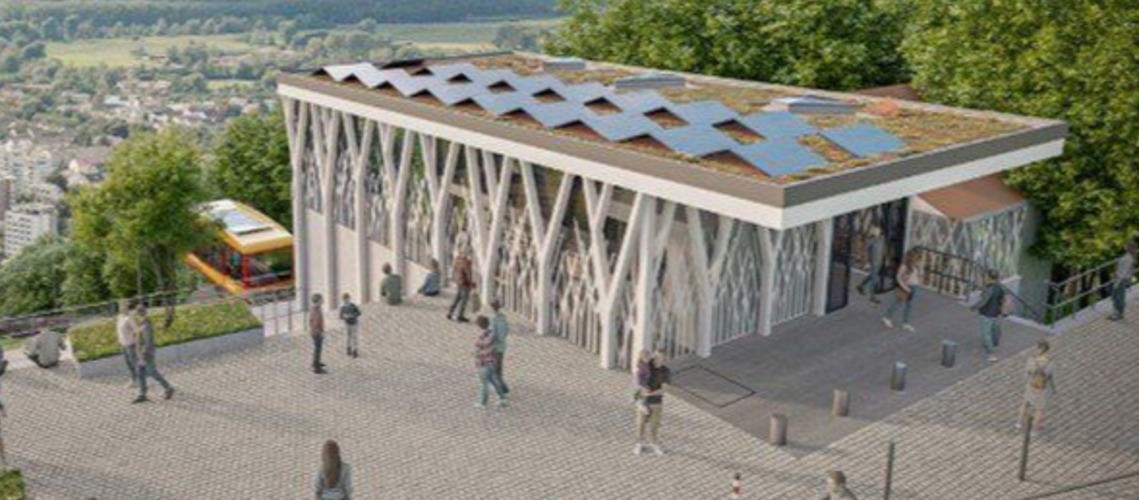
Plans for the Turmberg Railway envision a comprehensive modernization, barrier-free upgrade, and extension to Grötzinger Straße (B 3). Simultaneously, the railway will be brought up to current technological standards and safety requirements. "The funding of this project by the state of Baden-Württemberg sends a strong signal for the further development of public transport in Karlsruhe. We are pleased that we now have planning certainty in this aspect as well, enabling us to implement the project and initiate the next steps," explains Christian Höglmeier, Technical Director of VBK, thanking the state for its support. VBK can now open the next chapter in the long history of the Turmberg Railway, which has been transporting passengers to Karlsruhe's local mountain since 1888.
Renovation work will begin in spring 2026
The first phase of the project involves dismantling the old railway line and the current valley station. Following this, work can begin on the new line and the new mountain and valley stations. As part of the redesign, a railway overpass will also be built over a pedestrian and cycle path to cross the intersection of Bergbahnstraße/Turmbergstraße/Posseltstraße/Kastellstraße. The reconstruction work is scheduled to begin in spring 2026.
New vehicles and public transport integration
The state of Baden-Württemberg is also supporting the purchase of two new vehicles, each with space for 70 people and equipped with level control so that the trains are kept horizontal during travel and accessibility is ensured, with a further 1.755 million euros.
Furthermore, plans are in place to integrate the funicular railway into the Karlsruhe Transport Association (KVV) fare system after completion of the construction work. This will allow passengers to use the railway with their regular public transport ticket. The planned automated operation will then allow for extended operating hours while simultaneously reducing operating costs.