Franzoni Stuns Kitzbühel With Maiden Downhill Victory, Odermatt Takes Second

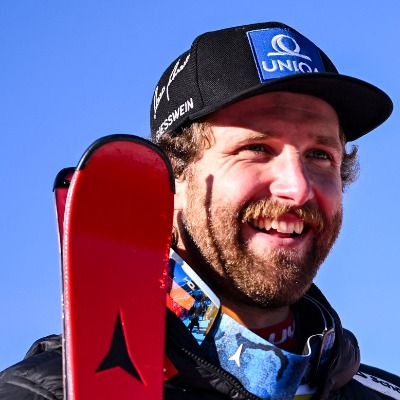
Giovanni Franzoni (ITA/Rossignol) produced the ski of a lifetime to win the legendary Kitzbühel Downhill on Saturday, finishing narrowly ahead of Marco Odermatt (SUI/Stöckli), whose quest to win the prestigious battle on the Streif goes on.
Franzoni has had a phenomenal, breakthough January: he claimed his first ever Audi FIS World Cup Super G victory in Wengen last week, before grabbing a debut Downhill podium a day later.
Now the 24-year-old has got one of the biggest achievements in winter sport in his back pocket – with a home Olympic Games looming.
Odermatt, who has this race at the top of his bucket list, recorded his third runners-up finish here.
Maxence Muzaton (FRA/ Rossignol), meanwhile, enjoyed the best day of his racing career. Starting bib no.29, he put it all on the line on the Streif – and it paid off.
Muzaton led on the opening section, and held on to record third place. His last World Cup podium came in 2017 – a silver medal in Alpine Combined.
The 23-year-old Italian delivered a fearless, attacking run down the most famous and feared course in alpine ski racing, navigating the Streif's notorious sections with a combination of technical precision and raw courage that has eluded many more experienced competitors. Franzoni's winning time gave him a narrow margin over Odermatt, who was seeking to add the prestigious Hahnenkamm downhill title to his ever-growing collection of victories.
The result represents a breakthrough moment for Franzoni, who has shown flashes of brilliance in speed events throughout his young career but had never before reached the top step of a World Cup podium. To achieve that milestone on the Streif—in front of the sport's most knowledgeable and passionate crowds—adds special significance to an already momentous achievement.
Odermatt's second-place finish demonstrates his continuing evolution as a complete racer, extending his dominance beyond the technical and Super-G disciplines where he has established near-total supremacy. The Swiss star's ability to challenge for downhill victories, even against pure speed specialists like Franzoni, underscores the versatility that makes him the sport's most formidable competitor.
Odermatt was always going to be the athlete with the mixture of skills to beat bib number one, and he had the green light for much of his run.
He was a man on a mission, solid through all the speedy sections – but it was during the more technical turns, which normally work in his favour, that he lost time to the Italian. Odermatt finished just +0.07 seconds adrift.
He was openly crestfallen at the finish: this had been a real focus. “I feel stupid that I can be that disappointed about second place, here in Kitzbühel but we all knew that today, victory was my big goal, my big dream,” he said. “I didn’t make it.”
It was pointed out that fellow Swiss legend Beat Feuz took a long time to win here, but eventually secured three triumphs in a row.
“Sure, but you also never know,” responded Odermatt. “It’s a privilege that you can come here with a red bib, with such a good shape, with a body that does exactly what you want, a mind that is hungry for this victory. Skis that are working perfectly. Many things need to fit together to fight for the top spot, and you never know when will be the next time. I was very happy with the run. I could ski my plan and it was a very good plan. But Giovanni was seven hundredths faster. It was not enough.”
The Hahnenkamm downhill unfolded under ideal conditions on the Tyrolean slopes, with sunshine and a well-prepared course allowing racers to push the absolute limits on a track that demands respect at every turn. The Streif's legendary sections—including the Mausefalle, Steilhang, and Hausbergkante—tested every aspect of downhill skiing, from technical precision to physical courage.
Franzoni's victory provides Italian skiing with a much-needed boost in the men's speed events, a discipline where the nation has not consistently challenged at the highest level in recent seasons. Italy has produced numerous downhill champions throughout ski racing history, and Franzoni's breakthrough suggests the current generation may be ready to reclaim prominence in the discipline.
The drama of Saturday's race captivated the enormous crowds that pack the slopes and grandstands along the Streif for Hahnenkamm weekend, the sport's most attended and celebrated annual event. The combination of a first-time winner and the ever-popular Odermatt providing fierce competition created the kind of compelling narrative that makes the Kitzbühel downhill special.
For Odermatt, the near-miss on the Streif represents one of the few remaining gaps in his palmares. While he has won nearly everything else in alpine skiing—including Olympic gold, World Championship titles, and multiple overall World Cup crowns—the Hahnenkamm downhill has remained elusive. His second-place finish demonstrates he has the speed to contend but highlights the slim margins that separate victory from the podium's lower steps on the World Cup circuit.
Franzoni's approach to the Streif showed the fearlessness of youth combined with mature race tactics. He attacked the course's most challenging sections while maintaining the control necessary to avoid the costly mistakes that have derailed countless downhill runs on this unforgiving slope. His ability to ski aggressively without crossing the line into recklessness proved decisive.
The Italian's victory also speaks to the depth of talent emerging in men's downhill racing, where multiple nations are fielding strong competitors capable of winning on any given race day. The traditional downhill powers—Austria, Switzerland, and Norway—now face challenges from racers like Franzoni who represent nations rebuilding their speed event programs.
The Hahnenkamm weekend represents the pinnacle of the downhill calendar, and Franzoni's name now joins the honor roll of champions who have conquered the Streif. The victory will provide confidence and momentum as he pursues additional success throughout the remainder of the season and in future campaigns.
For the Swiss team, Odermatt's strong performance—combined with Friday's Super-G victory—demonstrates the nation's continued dominance across multiple disciplines. While missing the downhill win surely disappoints, Odermatt's consistency in securing podium finishes across all events continues to build his commanding lead in the overall World Cup standings.